The past two weeks found us in Chandigarh. But when the thermometer began to breach 45°C, we decided it was high time to seek a mountain escape and head into the Himalayas.
Typically, people from Chandigarh travel to Manali or Dharamshala. However, at the peak of the season, these destinations dissolve into an endless stream of cars, tourists, and noise. We wanted something completely different—silence, fresh air, and a sense of vast, open space. That is when I remembered a long-held dream: to visit the Roerich family estate in the Kullu Valley, tucked away in the small village of Naggar.
Kullu and Naggar: A Different India
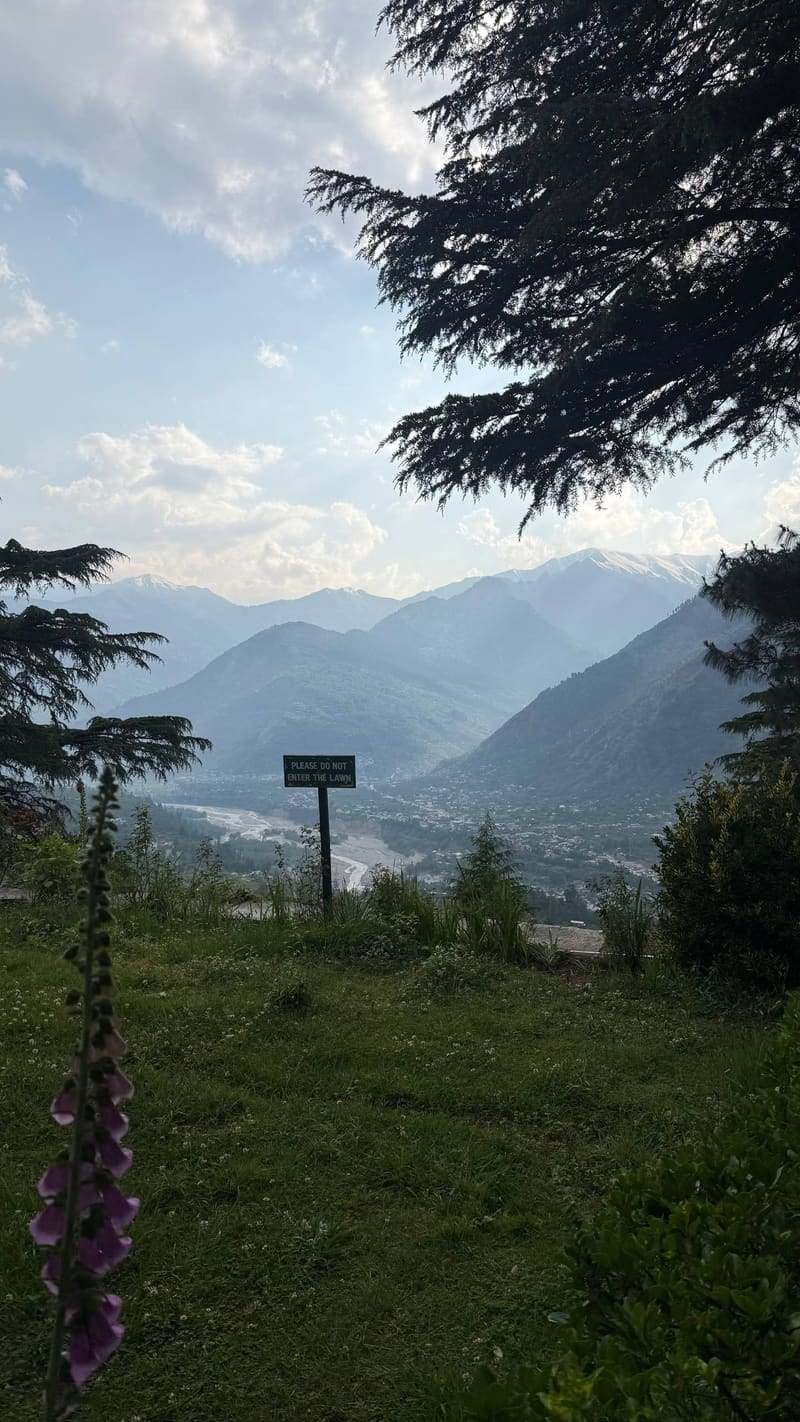
It turned out to be the perfect choice. Kullu and Naggar are wonderfully serene places. Here, everything is shanti-shanti, as they say in India: peace, quiet, and tranquility. Despite the daytime heat, the air turns crisp by evening, bringing that distinct sense of Himalayan comfort—sitting on a balcony overlooking the mountains, sipping hot masala tea, and enjoying a bowl of noodles.
Days here drift by slowly and peacefully. We spend a lot of time in cozy little book cafes with wooden terraces that overlook pine-covered slopes. Local cafes serve traditional Himalayan dishes: momo and siddu—a special regional bread that somewhat resembles Vietnamese bao, only in a vegetarian version.
We strolled through neighboring villages where traditional woolen goods are still hand-crafted to this day, and visited ancient temples, one of which dates back to the 9th century. It is precisely here that you truly feel a different India—one entirely removed from bustling megacities or crowded tourist tracks.
Beyond that, the area is full of charming, creative cafes serving delicious coffee. We found an especially great spot right across from our hotel called “German Bakery,” which serves an incredible tiramisu and other desserts.
The mountain temples are particularly inviting because they are free of crowds and long lines. You can easily find yourself completely alone, sitting in silence, gazing at the mountains, meditating, or simply watching the clouds slowly drift across the ridges. In moments like these, you begin to understand why the Himalayas have become a place of inner seeking for so many people.
The Roerich Estate: A Sanctuary of Spiritual and Creative Power
Yet, the true heart of Naggar—and the highlight of our trip—is undoubtedly the Roerich family estate. I spent two full days there, and it is a breathtaking place of power.
For me, Nicholas Roerich has always been a towering, inspiring figure. I often find my own thoughts aligning with his ideas regarding the profound connection between India and Russia. His spiritual and philosophical quests resonate so deeply within my heart that they move me to create.
During his lifetime, Roerich came to be respectfully addressed as Maharishi—a title of deep reverence reserved only for great sages. In Naggar, you will find a memorial complex (samadhi) dedicated to the artist, featuring a memorial plaque inscribed: “To the great friend of India, Maharishi Nicholas Roerich.”
The entire family was unique; every single member achieved profound creative fulfillment and made immense contributions to culture, science, history, and specifically to the bond between Russia and India.
Nicholas Roerich arrived in India following his monumental Central Asian Expedition—one of the most extraordinary journeys of the 20th century. Alongside his wife Helena and son George, he traversed Tibet, Mongolia, China, and the Himalayas, researching the culture, philosophy, and spiritual traditions of Asia. In the late 1920s, the family settled here in the Kullu Valley, where they lived for nearly twenty years.
It takes very little time to understand why they chose this exact spot. The estate stands nestled among pine trees high above the valley, facing the snow-capped Himalayan peaks. There is an astonishing, concentrated sense of stillness here.
How India Influenced the Roerichs’ Work
The Indian period of Nicholas Roerich’s work marked a vital stage in his life and artistic evolution. During these years, he fully crystallized his signature painterly language, where landscapes ceased to be mere depictions of nature and became vessels for philosophical and symbolic meaning.
The Himalayas became the central motif of his Indian period. In his paintings, they appear as a majestic realm of nature, inspiring reflections on eternity, spiritual fortitude, and the inner path of the human soul.
During this time, Roerich turned increasingly toward philosophical and spiritual ideas tied to the Theosophical tradition and Living Ethics (Agni Yoga), which developed in close collaboration with Helena Roerich. Helena played a pivotal role in shaping and developing Living Ethics; she spent 20 years working on the texts of this philosophical teaching. She was also a translator and philosopher in her own right, actively driving the family’s cultural and intellectual pursuits.
Nicholas Roerich’s artwork frequently features motifs connected to Eastern spiritual culture—imagery of Shambhala, Mahatmas, and symbolic representations of spiritual knowledge and human evolution. These themes reflect his lifelong interest in synthesizing the cultures and philosophies of East and West.
In 1928, the Roerichs founded the “Urusvati” Himalayan Research Institute in the Kullu Valley. It was envisioned as a scientific hub blending Western scientific methods with the wisdom of Eastern traditions. The institute conducted research in botany, ethnography, archaeology, and the cultures of Central Asia.
- George Roerich, the eldest son, became a prominent Orientalist and Tibetologist, specializing in the languages and culture of Central Asia.
- Svetoslav Roerich, the younger son, became a painter. He carried on the family’s artistic legacy while forging his own distinct style.
- Svetoslav married Devika Rani, a celebrated Indian film actress and one of Bollywood’s very first stars. Their union became a beautiful chapter in the cultural dialogue between Russia and India.
Who Should Visit the Kullu Valley?
Perhaps this rich history is exactly why the estate feels less like a sterile museum and more like a space charged with vibrant creative energy. I wholeheartedly recommend this place to anyone seeking a secluded, elevated experience, as well as to artists and creative minds.
I now have a new dream: to own a creative summer cottage (dacha) here, a place to escape during the hot season when temperatures soar in Bangalore.
Every single corner of this valley demands more than a quick visit; it requires time. You need to sit, meditate, and connect with the energy—whether you are in a temple, inside Roerich’s home surrounded by his paintings, walking through a pine grove, or just resting on a mountainside bench with an unforgettable view.