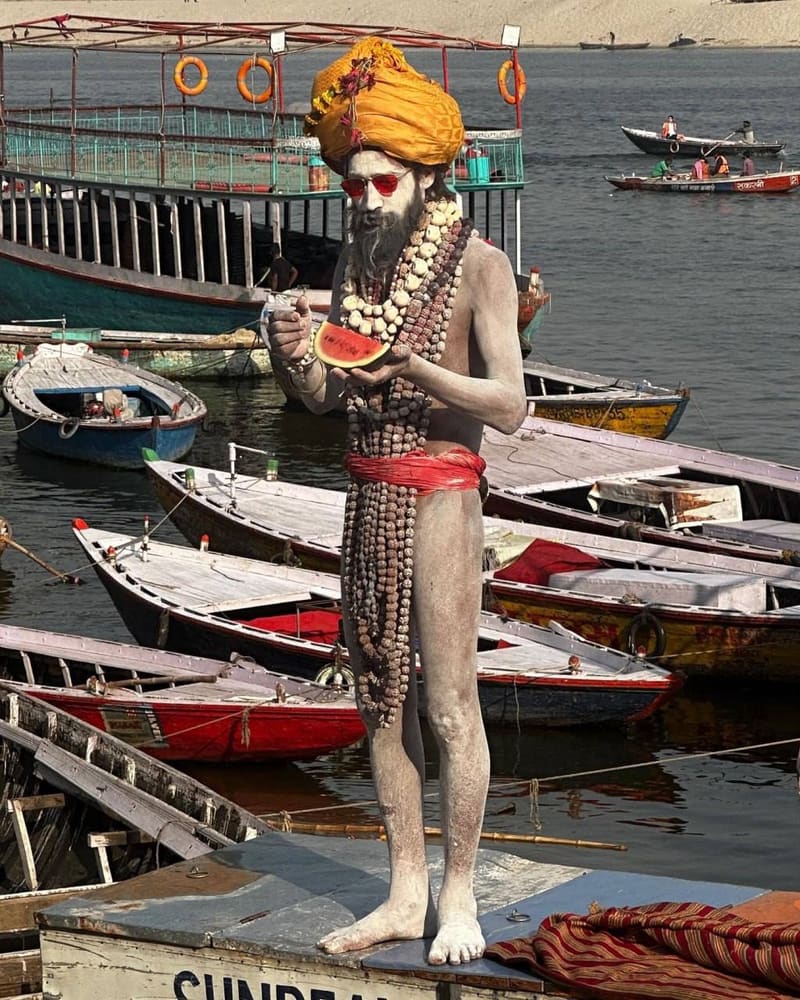
For most travelers, India is associated with vibrant colors, loud sounds, and dense crowds waiting at pilgrimage sites. But as you ascend higher—to where the air turns crisp and mountain peaks plunge into the clouds — the scenery changes dramatically.
The Himalayan temples and mountain monasteries offer a completely unique experience that has nothing in common with the bustling atmosphere of “mainland” India. This is where a different reality begins.

In these mountain sanctuaries, you won’t have to push through crowds just to catch a fleeting glimpse of the altar. On the contrary, in most of these places, you will find yourself in absolute solitude. Here, you can sit on the stone slabs for hours, meditating, listening to the wind, and absorbing the incredible ancient energy that literally fills the air.
During my journey through the Himalayas, I explored three key holy sites hidden away in the Kullu Valley: the ancient stone temples of Krishna and Shiva in the secluded town of Naggar, and a natural Shiva Lingam hidden beneath the spray of a waterfall near Manali.
1. Gauri Shankar Temple (11th–12th Centuries)
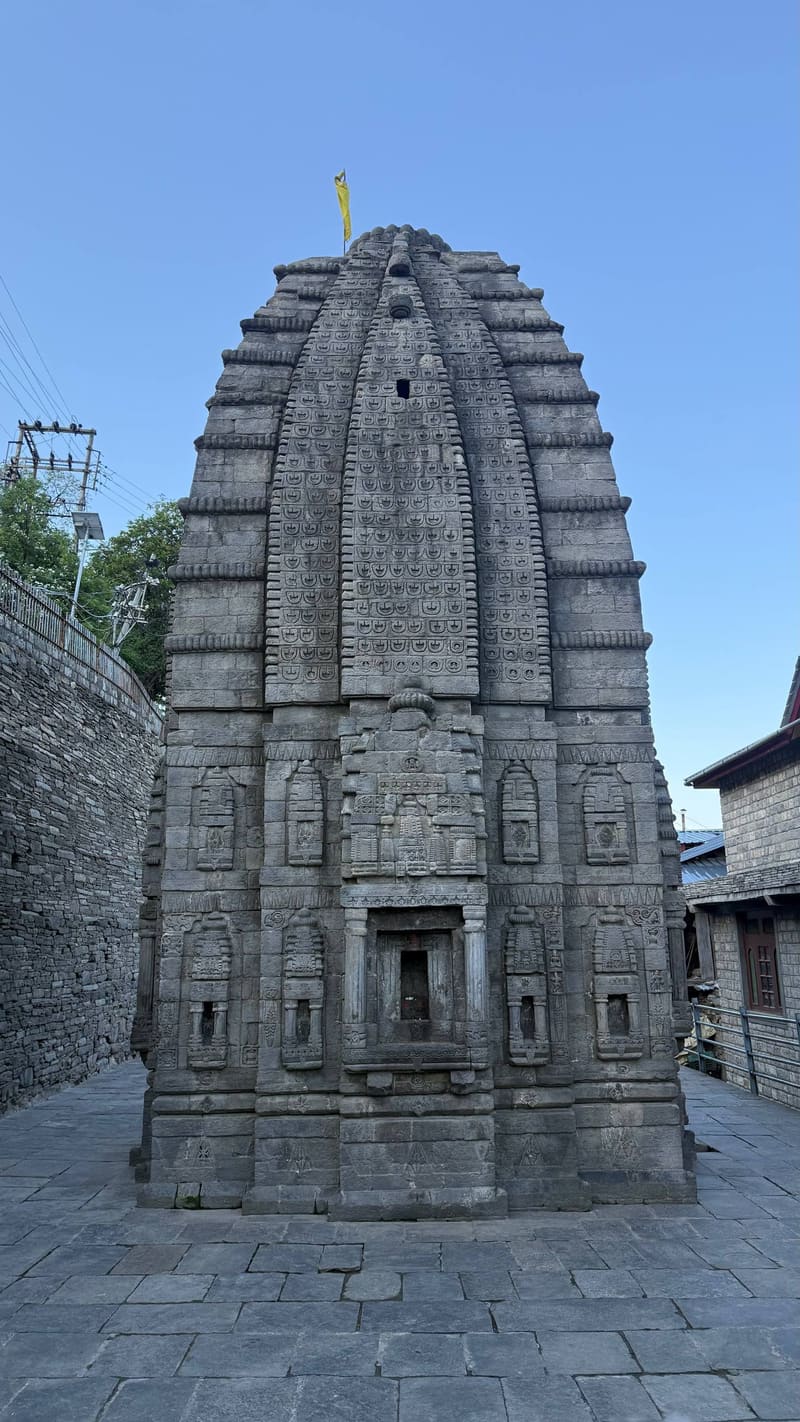
In the heart of the historic town of Naggar, on the steep bank of the Beas River, stands a monumental ancient landmark—the Gauri Shankar Temple, dedicated to Lord Shiva and his consort, Parvati.

This is not just a place of worship, but the last great monument of the Gurjara-Pratihara dynasty to survive in this region. Its architecture is striking: a chisel-carved stone shikhara (tower) soars high into the sky, while the sanctuary itself consists of five tiers that taper toward the top.

What makes this place special:
- Exquisite stone carvings. Every inch of the exterior walls is covered in intricate ancient bas-reliefs. Right above the main entrance, visitors are greeted by an image of the elephant-headed god, Ganesha. Flanking the doorway are the goddesses of the sacred rivers, Ganga and Yamuna, while the peace of the inner sanctum is guarded by fierce dvarapalas (gatekeepers).
- An architectural secret. The temple completely lacks a roof over its porch (mandapa). Due to this unique design, the first rays of the morning sun penetrate deep into the sanctuary undisturbed, softly illuminating the altar.
- Centuries of resilience. The temple was assembled from massive stone blocks without using any mortar. When a devastating Kangra earthquake shook the valley in 1905, destroying thousands of buildings, Gauri Shankar stood firm without a single scratch.
2. Murlidhar Krishna Temple (10th–12th Centuries)
If you head slightly uphill from Naggar, another ancient gem reveals itself among age-old trees—the Krishna Temple, widely known as Murlidhar. Translated from Sanskrit, this poetic name means “The Flute Holder,” which is one of the most beloved forms of Lord Vishnu worshiped here.


The stone base of the temple, built in the classic shikhara style, dates back to the 10th–12th centuries. The walls of Murlidhar feature carvings so delicate and intricate that it feels as though the master craftsmen worked with wood or wax rather than hard rock.
Interesting details:
- Echoes of a disaster. Unlike Gauri Shankar, this temple was partially damaged during the 1905 natural disaster. The original wooden dome at the top of the structure was destroyed, but local craftsmen later painstakingly restored it, returning the temple to its historical appearance.
- Echoes of the Mahabharata. Local legends deeply connect this site to the great Indian epic. It is believed that the temple was founded by the legendary Pandava brothers during their secret exile in the Himalayas.
- The legend of the escaping god. A colorful piece of folklore still circulates among the locals. For a long time, only a single statue of Krishna stood on the altar. The temple priests used to say that the young god grew lonely by himself and would regularly “vanish” from the locked temple—only to be found later in the deep forest or by the riverbank. These mystical escapes finally stopped a few centuries ago when a statue of his eternal beloved, Radha, was installed right next to him.

3. Anjani Mahadev Shiva Lingam
The third stop of the itinerary lies near Manali, not far from the Solang valley. Anjani Mahadev is not a conventional temple in the traditional sense, but a unique natural sanctuary hidden deep within the cliffs.

The natural site itself has been revered as holy since deep antiquity. According to legend, it was in this secluded mountain cave that Mata Anjani (the mother of the revered monkey god, Hanuman) spent 7,000 years in intense austerity and meditation, praying to Lord Shiva to bless her with a great son. The modest temple complex surrounding this shrine, however, was built relatively recently, back in the 1990s.

Why this place is mesmerizing:
- An eternal natural ritual. A powerful 30-meter waterfall cascades from a rocky cliff directly onto the stone Shiva Lingam. In Hinduism, abhisheka is a crucial ritual involving the ceremonial washing of a deity with water, milk, or oil. At Anjani Mahadev, this sacred rite is performed by nature itself, 24/7, continuously bathing the Lingam in ice-cold, pure mountain water.
- Winter metamorphosis. The most incredible sight awaits travelers during the winter months. With the arrival of severe frosts, the cascading water begins to freeze layer upon layer right on top of the Lingam. As a result of this natural freezing process, the shrine transforms into a giant ice stalagmite capsule as tall as a three-story building (ranging from 6 to 12 meters!). Because of this phenomenon, Anjani Mahadev is respectfully called “Chhoti Amarnath” (Mini Amarnath), named after the famous ice cave shrine in Kashmir.

The Himalayan temples of the Kullu Valley are not a story about religious tourism; they are a journey toward inner silence. Here, at the crossroads of ancient stone architecture, rugged cliffs, and roaring waterfalls, you clearly understand why these mountains have been considered the abode of gods and sages since time immemorial. It is a place worth ascending to at least once in a lifetime — if only to finally hear your own thoughts.