On the final day of our stay in Naggar, when I posted about the Roerich estate on my channel, I received a comment with a proposal to meet a well-known Russian artist, Natalia Zaitseva-Borisova. She lives and works directly in Naggar, is the only female artist permanently working in the Himalayan region, and is a true follower of the Roerich tradition.
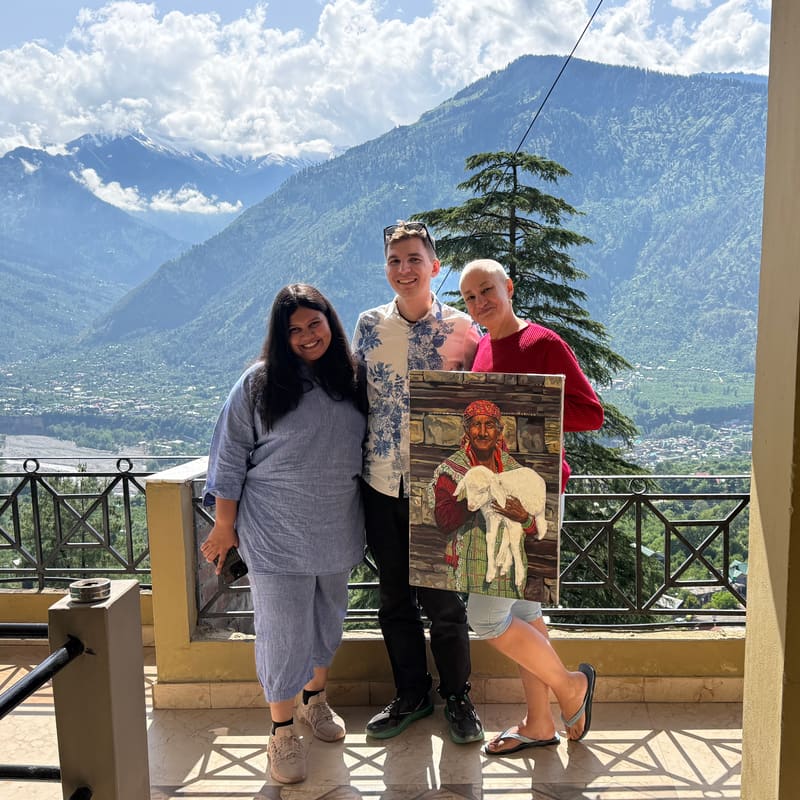
Of course, with great pleasure, I contacted Natalia right away, and we agreed to meet. She and her husband Alexander invited us over and treated us to delicious Russian tea. We spent about three hours chatting about art, India, Russia, the Himalayas, and each of our creative journeys.
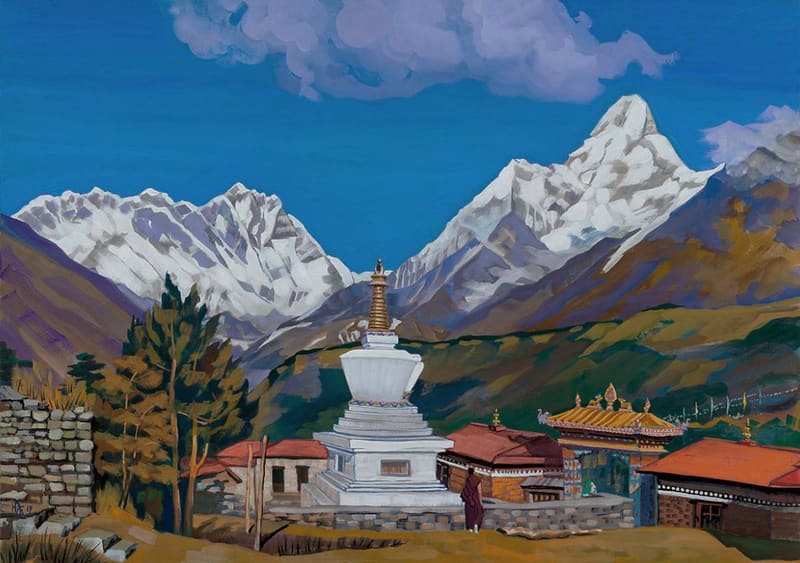
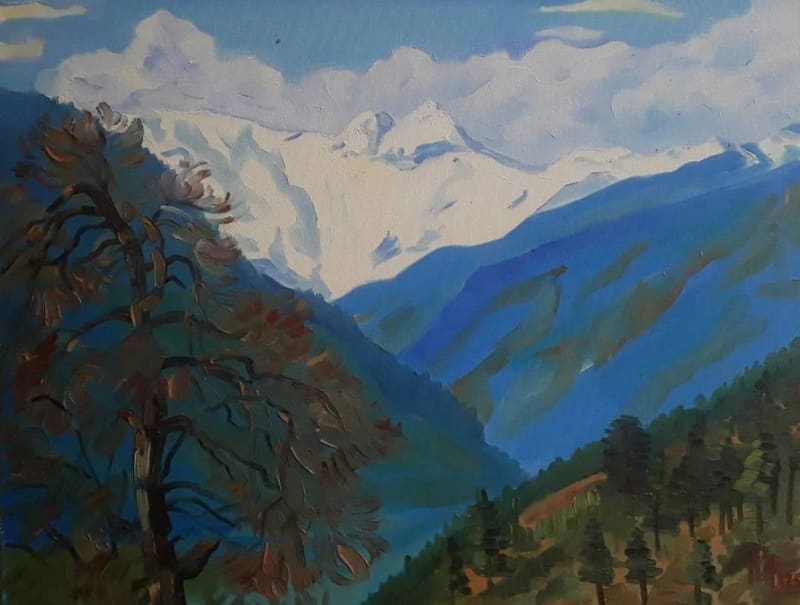
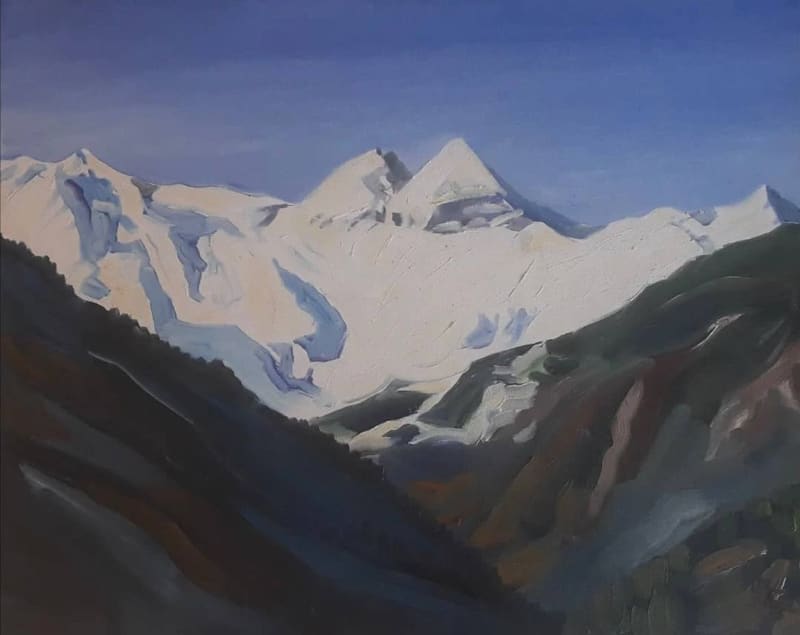
Natalia showed us a huge number of her works. Among them were entirely different painting techniques: both oils and watercolors, as well as many sketches in the Roerich tradition, which she painted all over the Himalayas—both Indian and Nepalese.
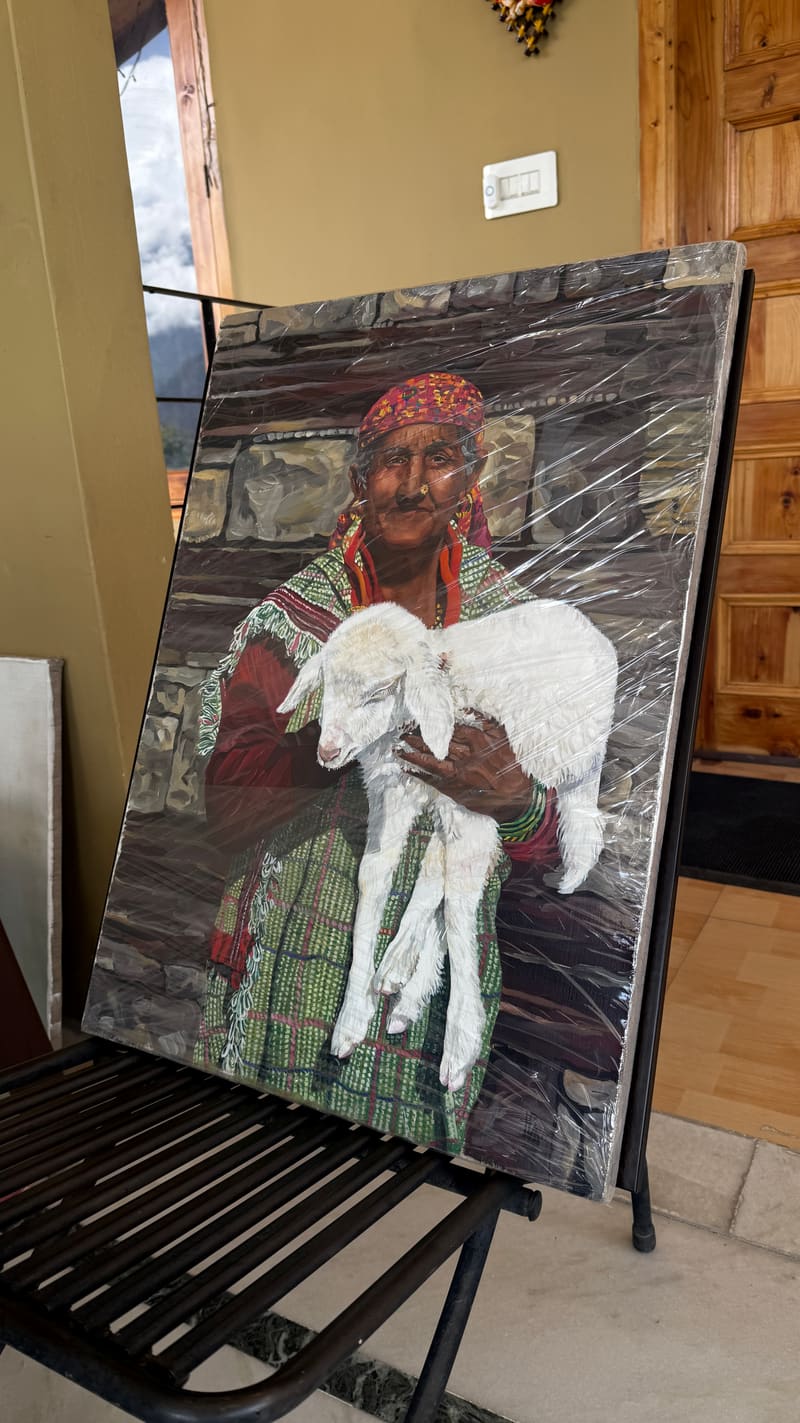
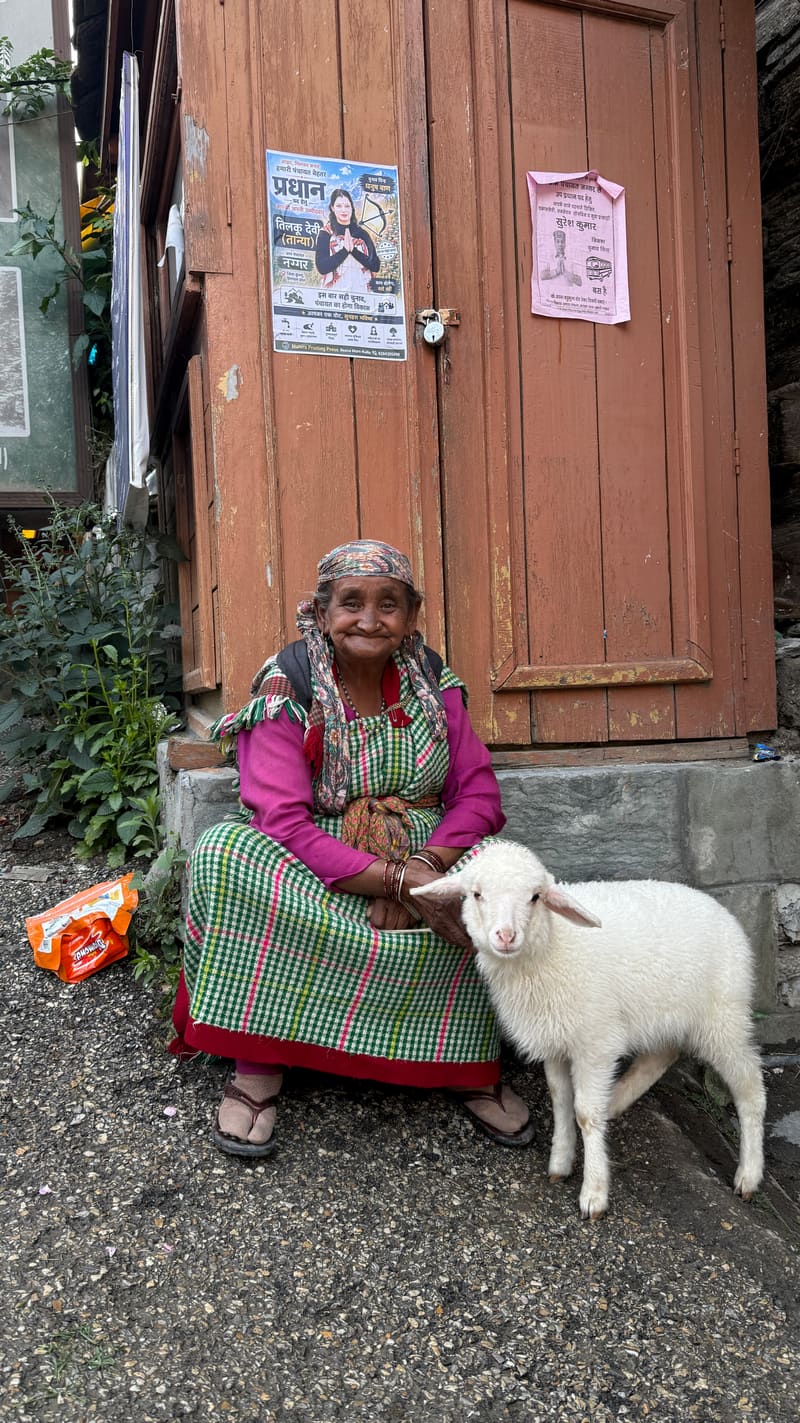
There were also amazing portraits of mountain village residents. I was particularly impressed by a portrait of a colorful woman with a lamb. Amazingly, as soon as we stepped out onto the balcony, we saw her in real life! It turned out that this woman allows tourists to take photos with her lamb for a small fee.

From Natalia and her husband Alexander (who worked for a long time at the Roerich Museum, where they, by the way, met), we learned a huge number of curious stories about Naggar and Roerich, the fate of the museum-residence, and much more.
By the way: Any of Natalia’s paintings are available for purchase with worldwide shipping! If you are interested in her art, write to me, and I will gladly connect you with the artist.
Biography: Natalia Zaitseva-Borisova
Natalia Zaitseva-Borisova is an artist working in the tradition of modern Orientalism. Her practice is formed at the intersection of the European art school and many years of personal experience living in Nepal, India, and Sri Lanka.
- Origin: Born in Smolensk in 1972. Currently lives and works in South Asia.
- Education: Received her art education in Smolensk and graduated from the Vitebsk State Technological University (Belarus), Faculty of Design, Department of Artistic Design.
- Professional Formative Years: Her early professional stage is connected with Russia and the Baltic region. During her period of living and working in Kaliningrad, her visual language took shape, and exhibition projects were held in Russia, Poland, Lithuania, and Sweden.
- New Context: Since 2006, South Asia has become the primary cultural and spiritual context of her work. A long stay in the region allowed the artist to go beyond an external ethnographic gaze and form an internal, lived lens of perceiving the space of the East.
- Main Theme: A central place in her practice is occupied by the “Himalayas” series, in which the mountain landscape is conceptualized as a metaphor for spiritual ascent and inner transformation. In the artist’s works, the landscape ceases to be geography and becomes a state — a space of silence, light, and contemplation.
- Recognition: Natalia has repeatedly visited the residence of His Holiness the Dalai Lama XIV, and also had a personal audience with the Karmapa, who highly praised her art and blessed her for art projects dedicated to drawing the attention of the Western viewer to Buddhist culture and philosophy.
- Techniques and Genres: Works in oil, watercolor, tempera, pastel, gouache, and mixed media techniques. The main genres are landscape, architectural landscape, portrait, and thematic composition. She also works in the field of book and botanical illustration. Over the years of her activity, she has held more than 30 solo exhibitions in Russia and abroad (a significant portion of the projects was realized in India).
In her artistic language, one can feel a dialogue with the tradition of the Russian school of Orientalism (Vasily Vereshchagin, Nicholas Roerich), while the painting retains an independent intonation based on personal experience of living within the cultural space of the East.
Exclusive Interview
— How did India change your view on art compared to what it was before?
— I will say right away that India did not change my view. It deepened it. The thing is, since my childhood, since my youth, I really loved Roerich’s paintings. Of course, later I became interested in his philosophy. And my other favorite artist was, just like Nicholas Roerich, a traveler—Vasily Vereshchagin. And suddenly in India, I saw how the paintings of my favorite artists came to life.
— Is there a place in the Himalayas where you feel inspiration or the presence of something greater particularly sharply?
— A wonderful question, it is difficult to answer it briefly. First of all—the high-altitude regions of India and Nepal, such as Ladakh, the Spiti Valley, Lahaul, the Kullu Valley in India, and Muktinath in Nepal. There is a special atmosphere there, amazing views, and wonderful character types among the local residents, who still live a traditional lifestyle.
— In the Roerich tradition, the Himalayas occupy an almost sacred place. What do they mean to you personally?
— For me personally, the Himalayas are a symbol of spiritual ascent and divine beauty. Also, the Himalayas are a very fragile ecosystem that is currently changing very significantly under the pressure of civilization. This affects the lifestyle of the local nationalities. Therefore, in my work, I want to draw attention to these problems and thus contribute to the preservation of the traditional lifestyle and culture of the local peoples.
— What does a typical day for an artist in the Himalayan region look like?
— Of course, days can be different… there are everyday chores, etc. But an ideal day is when you wake up, quietly drink tea prepared by your husband (masala chai, specifically Indian tea), and have a peaceful breakfast. And after that, the most interesting part begins—what happened today? Did it snow, and you can quickly set up your easel and work in oils? Or is it monsoon today, and you need to catch the stunning views with watercolor, which change instantly? Or is it better to work in the studio on long-term ideas? Or has a new rose flower or daffodils bloomed on the balcony, and they are waiting for you… In a few hours, a friend will call and say that they missed you and will come over to have some tea or dinner with you. And you will hold conversations on amazing topics and rejoice that you are together in the Himalayas. And in the evening, lights will begin to light up on the mountains and stars in the sky, and you can go out onto the balcony to admire it, to admire it endlessly, and then go to sleep and in this silence feel the breath of the Himalayas once again, knowing that tomorrow you will wake up happy again.
— Do you have any personal rituals or practices that help you maintain your inner state and inspiration?
— Of course, they were formed long ago. This is, first of all, the contemplation of nature. I even share this experience with my friends and tell them that it is very important at this time not to think about anything, but simply to listen and carefully watch what is happening around. And the process of creation itself is also a kind of meditation.
— Which few places in India would you recommend to a person who is looking not just for a trip, but for true inspiration and an inner experience?
— I would recommend, first of all, Ladakh and the Spiti Valley, especially the Tabo Monastery. And, of course, Naggar—for those who are interested in the philosophy of the Roerichs and their experience.
— Have you had a mystical or unexplainable experience in India that influenced your perception of the world?
— Yes, of course, and more than once.
— What is your favorite simple pleasure in India?
— Walking in the forest alone or contemplating beautiful landscapes, beautiful flowers, or simply the rhythm of this life at any given moment.
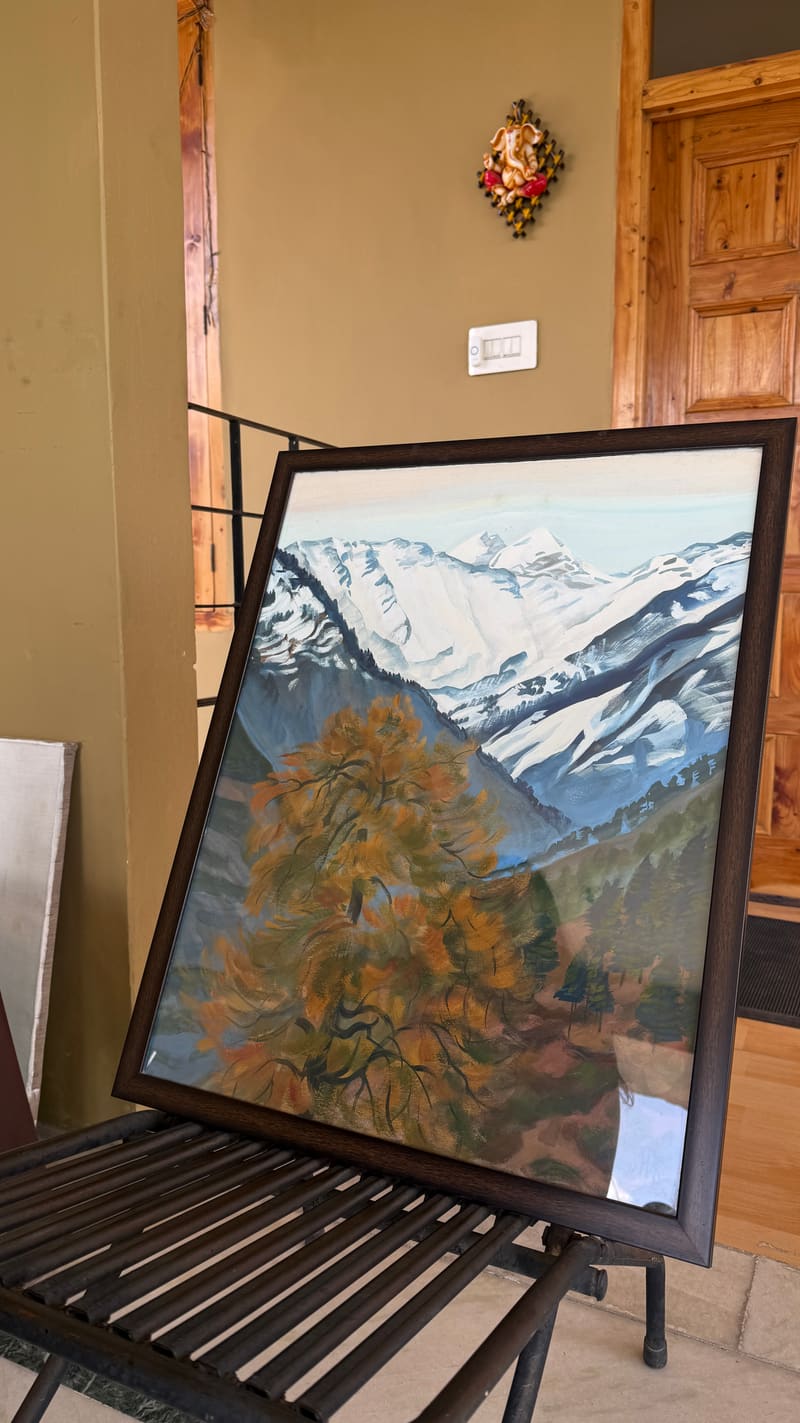
— Regarding the spiritual and cultural connection between Russia and India: do you feel it today, and how does it manifest for you personally? — It so happened in my destiny that Russia and India are my favorite countries and, you could say, they are two mothers. Therefore, the connection with them and the connection between them is very important to me. And, as an artist, I try to strengthen these relations at the level of spirituality and culture at my exhibitions. Sometimes there are amazing results at the personal level of communication between people, because art is capable of connecting people at a deep heartfelt level without the language of words. A Russian artist painting India for many years—that is already a connection between the cultures of the two countries. In essence, from this point of view, I am continuing the work of the artists Nicholas and Svetoslav Roerich.
— What is impossible to understand about India through photos and social media, but can only be felt in person?
— Of course, the atmosphere and the energy.